State of the Region Reports
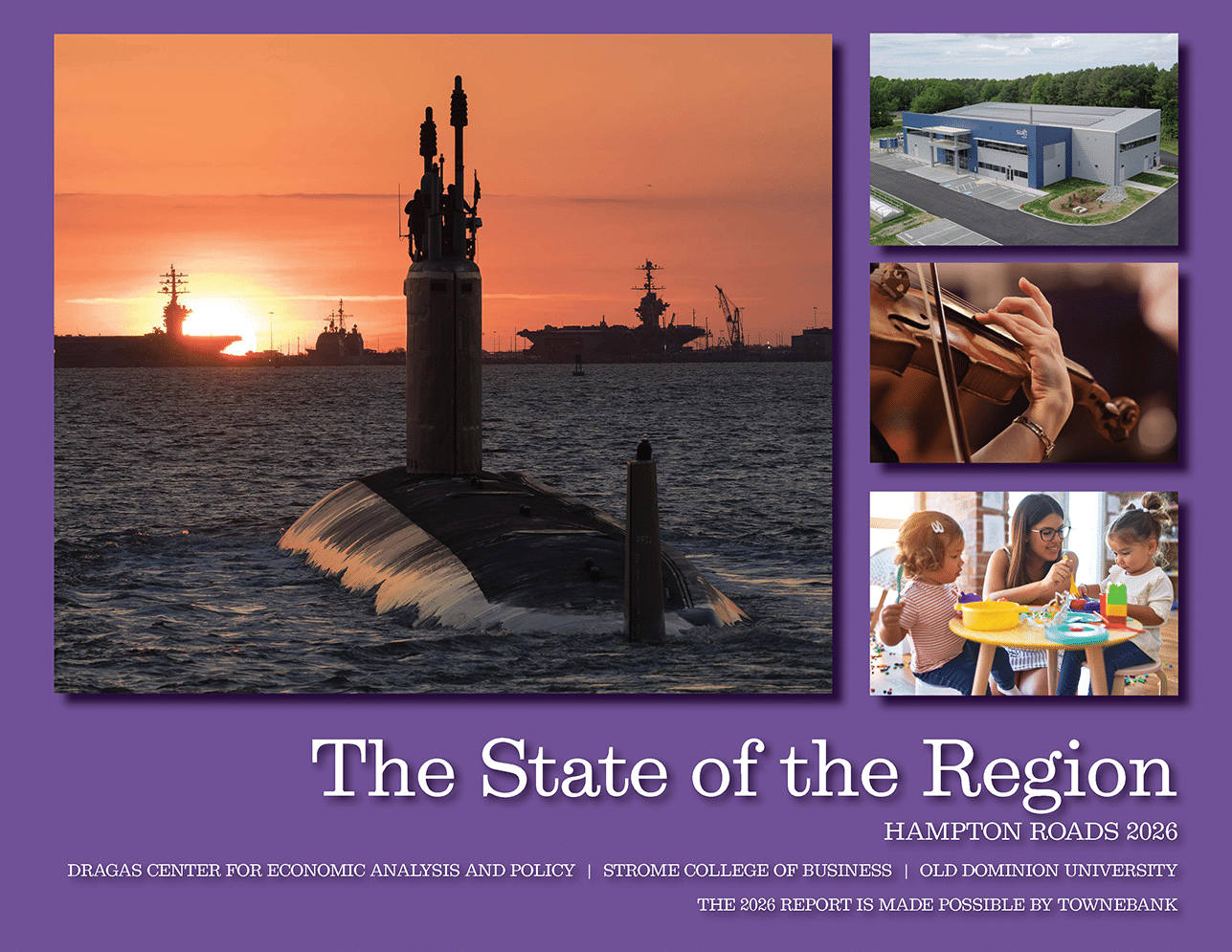
2026 State of the Region Report is Coming Soon!
In the State of the Region Report (SOR), Robert M. McNab, Director of the Dragas Center for Economic Analysis and Policy in the Strome College of Business at Old Dominion University, analyzes the Hampton Roads economy and assesses its future progress.
The 2026 State of the Region Report is divided into six parts.
We discuss the region’s economic performance in 2025 and provide an assessment of the prospects for growth in 2026 and beyond. We discuss how the resident population of Hampton Roads has grown this century and explore the components of population change. We examine measures of the region’s labor market, including its civilian labor force, individual employment, and nonfarm payrolls (jobs). While the evidence points to a continued expansion in 2026, we also note that the challenges to growth continue to mount.
The most recent economic data shows that the three-legged stool is tilting under the weight of conflicting economic policies. National defense spending has continued to expand, and we expect that, as a result, defense spending in Hampton Roads will also rise in the coming years. Declines in federal civilian employment will limit these gains, and the defense industrial base in the region faces an existential threat from the rise of uncrewed systems on the modern battlefield. The Port of Virginia performed well, gaining market share, but higher tariffs have negatively impacted the dollar volume of trade flowing through the Port. While the travel and tourism industry outpaced the post-pandemic national recovery, revenue growth has slowed, and real (inflation-adjusted) revenues have remained flat for several years.
The economic and social consequences of inadequate early childhood care and education (ECCE) are, by now, well known—but the problem is notoriously difficult to solve. To many working families, the quest for affordable, high-quality care seems hopeless. However, it is also true that our regional leaders are increasingly prioritizing this issue and are working together with early childhood experts to develop viable solutions. This chapter discusses ECCE from an economic perspective and explores why this market is so challenging to reform.
Hampton Roads hosts a remarkably vibrant and dynamic arts and culture ecosystem. It includes not only high-caliber professional institutions such as the Virginia Arts Festival, Virginia Opera, Virginia Symphony Orchestra, and Chrysler Museum of Art—but many other museums and galleries, theaters and performance spaces, open-air festivals, creative districts, public art, independent artists and creators, large performance venues for outside talent, and a wide array of professional and amateur arts organizations. This chapter discusses the
arts in Hampton Roads and explores its impact on the region.
In this chapter, we examine how the Hampton Roads Sanitation District (HRSD), in collaboration with localities, changed the regional approach to wastewater treatment, saving ratepayers from billions of dollars in additional costs. We discuss the SWIFT project and how it will inject treated, drinking quality water into the aquifer, partially offsetting the losses from residential and business use. We estimate the economic impacts associated with HRSD and SWIFT and note how HRSD serves as an example of how regional collaboration can produce
innovative benefits to the residents of Hampton Roads.
In this chapter, we discuss the state of housing in Hampton Roads. We focus on the supply side of the market for reasons that will become apparent throughout the chapter. We start with single-family housing and then discuss multi-family housing. We then explore factors that influence the supply of housing across the region. We conclude with actions that Hampton Roads can take to address the supply and, by extension, the affordability of housing in the region.